In POS, you can combine unpaid appointments into a single ticket—whether they belong to one client with multiple appointments or multiple clients with unpaid appointments. This lets you process payment for all appointments in one transaction.
Things to Know:
- The ability to check out multiple appointments on the same ticket in the POS is governed by the "Creating Tickets" access control permission.
- You can group past and current unpaid appointments for one or multiple clients.
- For multi-day appointments, the appointment appears in the Services tab on the end date, not the start date. For example, if a pet’s appointment is booked from June 8–12, it will not appear in the Services tab until June 12 (if unpaid).
- Using Packages and Membership Credits for Others: By default, MyTime allows a primary client to pay for another client’s services using their own package or membership credits, provided all services are combined on a single checkout ticket. To ensure credits are applied correctly, keep these three rules in mind:
- The Ticket Holder Rule: The system only looks at the balance of the Ticket Holder (the primary client listed in the top-left corner of the POS ticket).
- Automatic Priority: If both the primary client and their guest have credits, the system will default to the Ticket Holder’s balance. It will not pull from the other client's individual balance if they are on someone else's ticket.
- The Single Ticket Requirement: Credits can only be shared if all services are checked out on the same ticket.
- If your business utilizes Pet or Family Member profiles, sharing behavior depends on the membership/package type:
- General Memberships/Packages (Configured for all pets or family members): These credits are "fluid" and can be shared freely between any profiles combined on the ticket.
- Individual Memberships/Packages: If a membership is restricted to a specific pet or family member, those credits are locked. They cannot be shared and can only be redeemed by that specific individual.
- You can manage this behavior via the "Allow membership item credits and package items to be used by different clients on the same ticket" setting on the Business Setup > Settings page. If this is disabled, the ticket holder’s credits will only apply to their own services, and any guest services on that ticket will require a separate form of payment.
- Automated Voiding for Canceled Authorization Holds: The system automatically releases the hold and voids the transaction behind the scenes the moment an appointment is canceled. This enhancement applies universally across both Stripe and Cloud9 processing environments.
- Automatic Ticket Removal: When a client has a future appointment and you process a credit card in POS using "Print & Settle Later," the ticket securely moves to the Unsettled Transactions tab. If that appointment is later canceled via the Scheduler:
- The system instantly communicates with your payment gateway (Stripe or Cloud9) to fully void and cancel the authorization hold.
- The ticket is immediately deleted from your Unsettled Transactions tab. If no other pending balances remain, the screen will display: "No unsettled transactions match your filters."
- Restoring "No-Show" Appointments: If you previously marked an appointment as a no-show but later changed its status back to "Showed Up" from the Scheduler:
- The appointment slot will return to your calendar normally.
- Because the original authorization hold was already securely voided at the gateway level upon cancellation, the financial hold will not be automatically reinstated. Staff will simply need to open the POS ticket and authorize or swipe the card again when the client arrives.
- Handling Multi-Appointment Tickets: If a client has a single ticket containing multiple appointments, but an authorization hold was placed specifically for only one of them, canceling just that single appointment will release the hold and remove the ticket from your 'Unsettled Transactions' list without disrupting or modifying the remaining appointments on the calendar.
- By default, payment buttons may lack visual prominence, making it difficult for staff to quickly identify the primary payment method. This can lead to selecting incorrect options or improper transaction processing. You can request a layout change that reorders the buttons and highlights the primary action in blue for better visibility.
- Default Display:
- No Card on File: [Key In Card] [Swipe Card]
- Card on File: [Visa ****1234] [Key In Card] [Swipe Card]
- Enhanced Display (High Visibility):
- No Card on File: [Swipe/Tap Card] (Highlighted) [Manual Entry]
- Card on File: [Visa ****1234] (Highlighted) [Swipe/Tap] [Manual Entry]
- Important: This is controlled by a hidden setting that must be enabled by the MyTime team. If you would like to switch to the high-visibility payment buttons, please contact us at support@mytime.com
- Default Display:
- When a non-standard payment method is used for a transaction or a refund, it will be labeled clearly in your records:
- Payments: Displayed as "Other Payment Received" followed by the specific method in brackets—for example, (PayPal) or (Apple Pay).
- Refunds: Displayed as "Other Refunded" with the specific method noted in brackets.
- These detailed labels also extend to the Tickets and Journals API endpoints. Rather than returning a generic "Other Payment" label, the API provides the actual payment name (e.g., "PayPal") within the name field.
- Unsuccessful Payment Visibility: To provide better clarity during checkout, the 'Take Payment' and 'Closed Ticket' pages display unsuccessful transactions. This includes payments that have failed, been declined, or canceled. Each failed transaction displays:
- Card brand and last four digits
- A red status badge indicating the result (Failed, Declined, or Cancelled)
- The transaction amount shown in red with parentheses (e.g., ($50.00))
- An expandable caret (⌄) is available next to the card details. When selected, it reveals additional information such as:
- Error type
- Error code
- Payment gateway (e.g., Stripe, Cloud9)
- This allows staff to quickly identify the reason for the failure and take appropriate action.
- Error type
- Example: Declined Card
If a client attempts to pay $120.00 but the transaction is declined, the ticket will display:
Visa •••• 4240 [Declined] ($120.00) >
Expanding the caret will show:
Type: card_error
Code: insufficient_funds
Gateway: Stripe
On the Take Payment page, a "Max" button is available next to the Other Payment field. Clicking this button automatically fills the field with the remaining balance due. Example: If a client’s total is $100 and $60 has already been paid by credit card, clicking "Max" will automatically enter the remaining $40 in the Other Payment field.
Contents:
- Grouping Appointments For The Same Client on the Same Ticket
- Grouping Appointments For Multiple Clients On The Same Ticket
- Grouping Appointments For Multiple Clients On the Same Ticket (When One Has A Membership/Package)
Grouping Appointments For The Same Client on the Same Ticket
To combine multiple unpaid appointments for the same client into a single ticket, follow these steps:
- Navigate to POS > New Ticket
- Search for the client in the search field under the Services tab
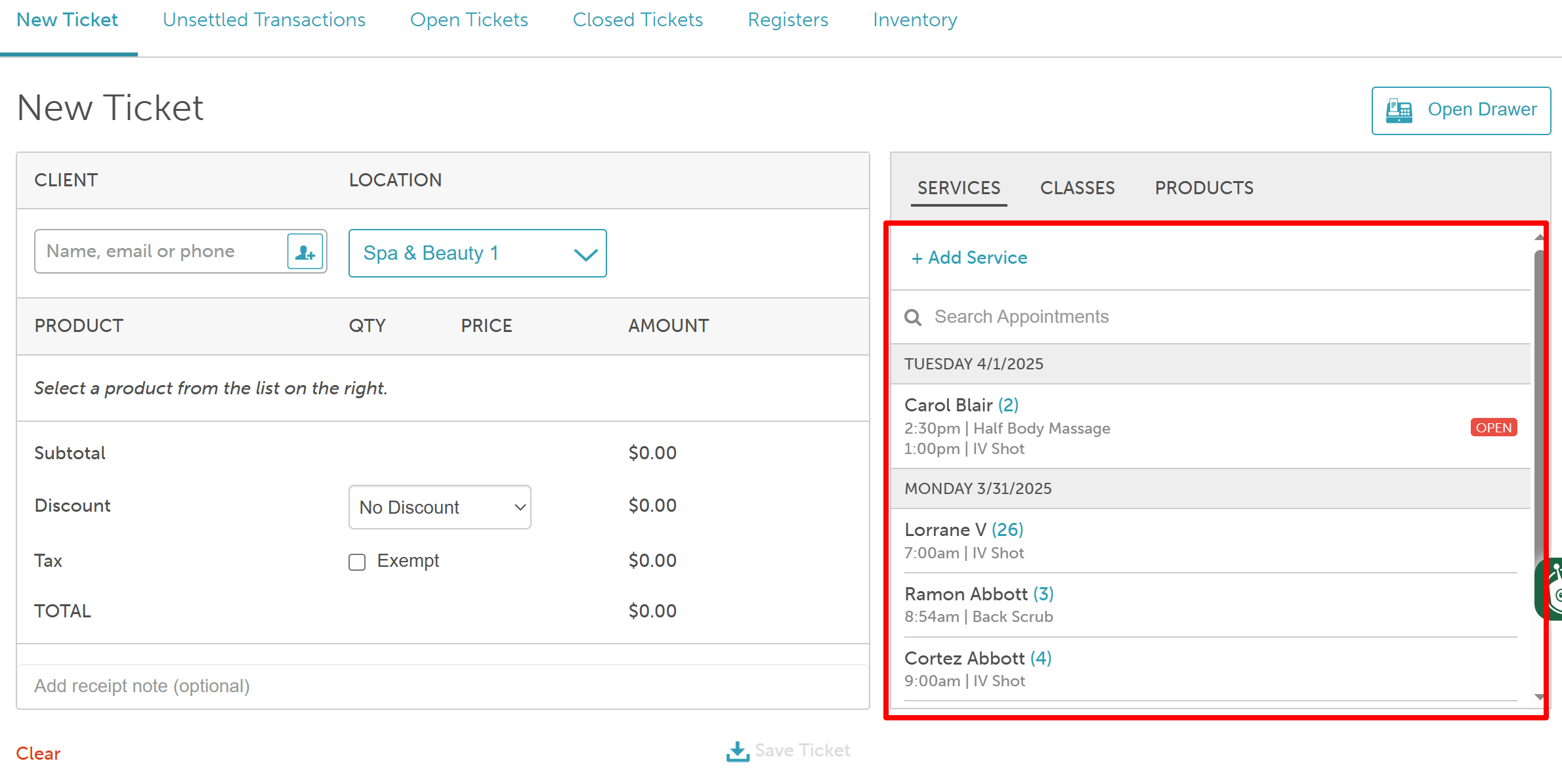
- Select all unpaid appointments for the client
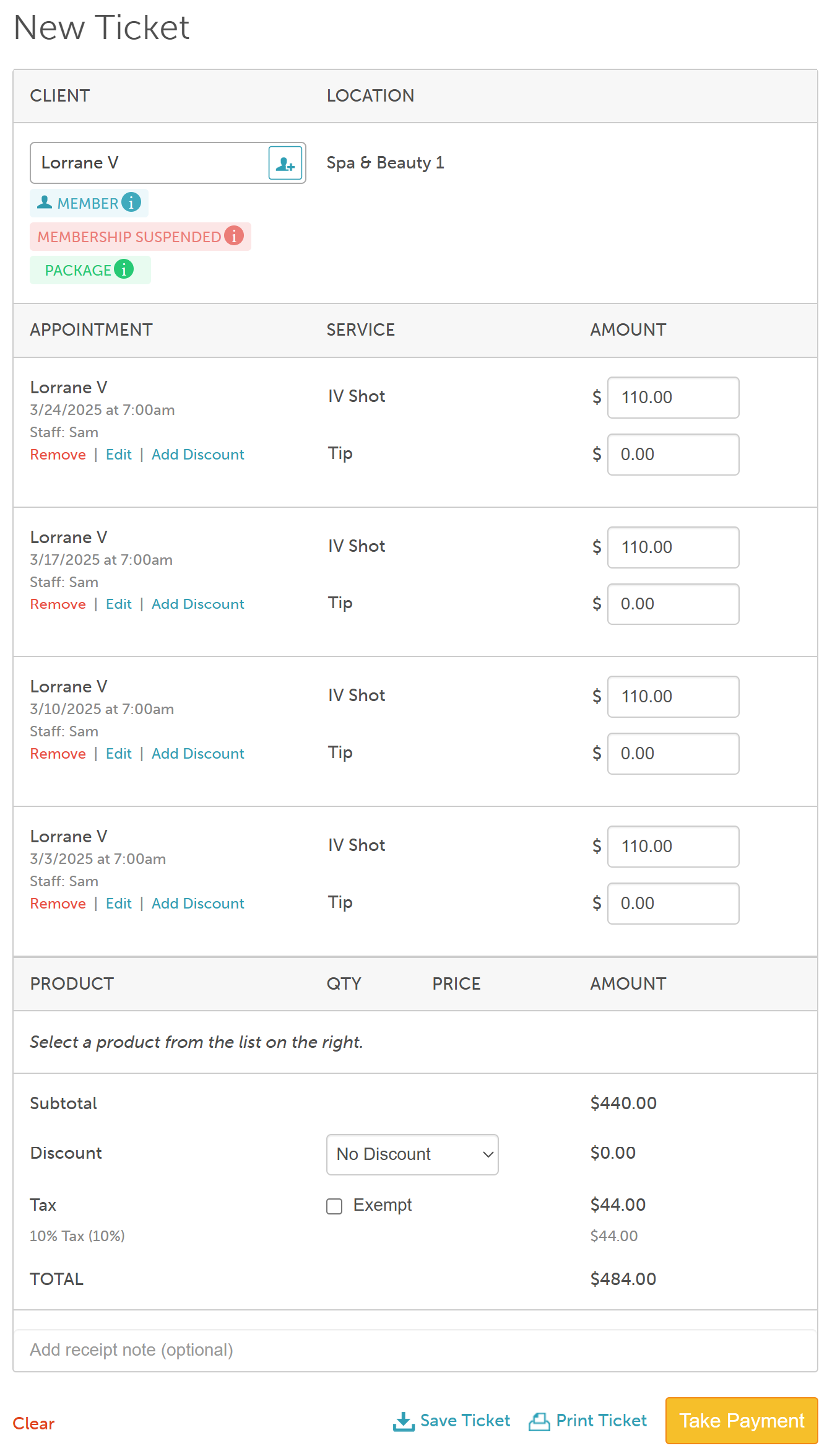
- Once all appointments have been added, proceed to payment and close the ticket
Grouping Appointments For Multiple Clients On The Same Ticket
You can combine multiple unpaid appointments for multiple clients into a single ticket by following these steps:
- Go to POS > New Ticket
- In the service tab, select all unpaid appointments for multiple clients
- The first selected client’s name will appear in the Client section of the ticket.
- Select the unpaid appointment for any additional client(s)
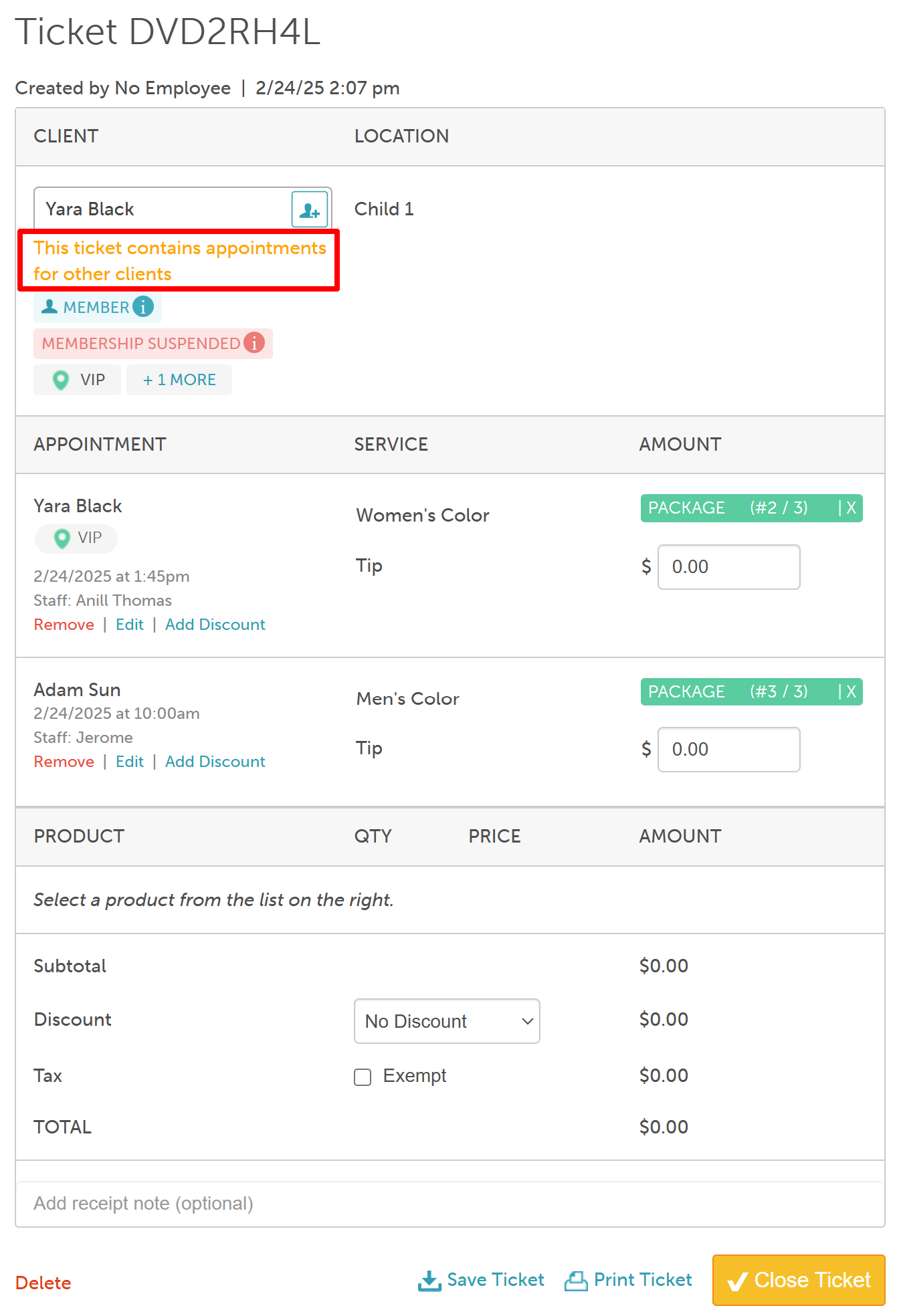
- Once multiple clients have been added, a "This ticket contains appointments for other clients" message will appear
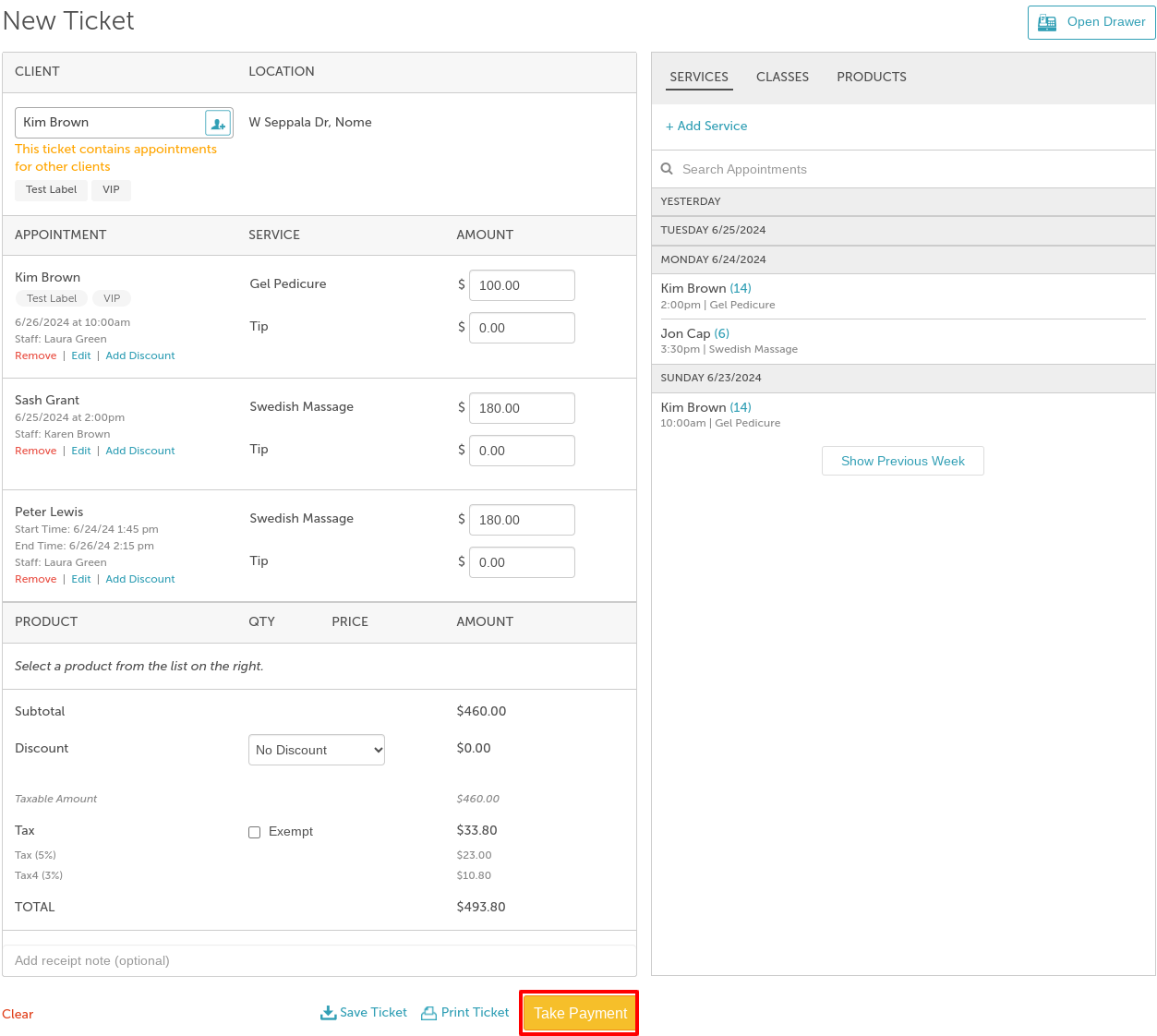
- Once all appointments have been added, proceed to payment and close the ticket

Grouping Appointments For Multiple Clients On the Same Ticket (When One Has A Membership/Package)
You can apply membership or package item credits to multiple clients on the same ticket by following these steps:
- Go to POS > New Ticket
- In the service tab, select all unpaid appointments for multiple clients
- The first selected client’s name will appear in the Client section of the ticket. To apply membership or package credits across all appointments, the first client must have an active package or membership

- If multiple clients are included on a ticket, the system will display, "This ticket contains appointments for other clients."
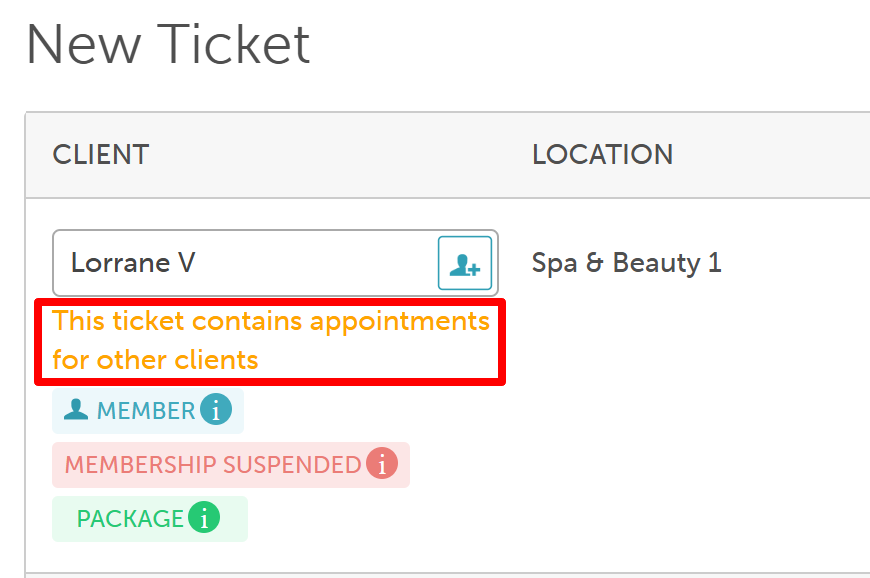
- If the first client has a membership or package with item credits, and the "Allow membership item credits/package items to be usable for different clients on the same ticket" setting is enabled, their credit will also apply to the second client's appointment
- Once all appointments are added, proceed to close the ticket
For more information, contact us at support@mytime.com.
Related Articles:
Was this article helpful?
That’s Great!
Thank you for your feedback
Sorry! We couldn't be helpful
Thank you for your feedback
Feedback sent
We appreciate your effort and will try to fix the article