MyTime allows franchise businesses on the global database to customize manual campaigns at both the parent and child levels. This article outlines the steps to configure and send campaigns directly from the parent account for franchise businesses.
Things to know:
- This feature is available only for accounts using the global database and must be enabled by a MyTime team member.
- To send global marketing campaigns from both the parent and child accounts, the Global Database checkboxes must be enabled at both levels. In addition, the “Marketing Campaigns on Parent Account” hidden setting must be enabled on the parent account. Please contact our support team at support@mytime.com to have these settings enabled.
- Once these hidden settings are enabled, global campaigns can be created and edited, provided the "Accessing Email Campaigns" access control is set to Edit.
Global Campaign Billing & Cost Allocation: When managing marketing campaigns from a parent account, subscription requirements and campaign usage costs are structured as follows:
Parent Account Subscriptions: A parent account does not require its own standalone subscription to build and send global marketing campaigns. However, if the parent account chooses to maintain an active subscription tier (e.g., Premier), it will be billed at the standard monthly or yearly rate configured for that tier.
Campaign Cost Allocation: When global campaigns generate usage fees (such as per-message SMS or email charges), the billing distribution depends on your account settings:
Default Behavior (Parent-Paid): By default, the parent account covers 100% of the usage fees for any marketing campaigns initiated and sent from the parent level.
Child-Level Billing Option: Parent accounts can choose to automatically route campaign usage fees down to the individual child accounts. This cost-allocation feature is controlled by the "Children Pays for Campaign sent from Parent" hidden setting that can be enabled by our team; please contact our support team at support@mytime.com to have this enabled.
How Child-Level Billing is Calculated: Once child-level billing hidden setting is enabled, the system determines which child location to bill based on the recipient's profile:
If the client is associated with one location, the charge goes to that specific child location
If the client is associated with multiple locations and has a preferred location set, the charge goes to that specific child location (based on the client's preferred_location_id).
If the client is associated with multiple locations but has NO preferred location set, the charge falls back to the parent account, as the system cannot choose between the multiple options.
If the client is a lead, the charge automatically defaults to the Parent account
- SMS Segment Calculation & Billing:
SMS costs are calculated per segment, not per message. Carriers treat each segment as a separate message for delivery and billing, so every segment is counted and charged individually. This billing method is determined by carriers and is not specific to MyTime.
Segments per message are based on length and encoding
- Encoding Standards
GSM Encoding:
GSM-encoded messages (standard letters, numbers, and symbols) allow up to 160 characters per segment.
If the message is longer than 160 characters, it will be split into concatenated segments of 153 characters each.
UCS-2 Encoding:
UCS-2 messages (special characters, emojis, or non-Latin alphabets) allow up to 70 characters per segment.
If the message is longer than 70 characters, it will be split into concatenated segments of 67 characters each.
Even a single emoji forces UCS-2 encoding, reducing per-segment capacity and potentially doubling the number of segments.
Note: Concatenation headers are hidden data that let the recipient’s phone reassemble multiple segments into a single message.
Each recipient receives their own copy, so the number of segments per message is multiplied by the number of recipients to calculate billing. Example: A 2-segment message sent to 50 recipients counts as 100 billable segments. If each segment costs $0.02, the total cost would be 100 × $0.02 = $2.00.
- Learn more about SMS segments & billing here.
- For child accounts with the global database for marketing campaigns enabled, any customizations made to campaigns at the parent level will automatically apply to and be available at the child level.
- At the child level, both global and local campaigns will be visible.
- Global campaigns will be marked with a globe icon to distinguish them from local campaigns.
- When sending a campaign from the parent account, clients who have not opted in to receive email or SMS marketing, or who lack an email address or phone number on file, will be excluded from the recipient list.
- Revenue tracking and delivery statistics (e.g., number of messages sent, bounced, opened, etc.) for global campaigns will be available only on the parent account.
- Delivery options for global campaigns can be edited at the parent level, but are view-only at the child level and cannot be modified.
- When viewing campaigns under Marketing > Campaigns > Sent, the Sent Campaigns list displays the Campaign Subject instead of the template name. Since each campaign can have a different subject line and message, displaying the subject helps staff quickly recognize the purpose of each campaign. For example, if a campaign was sent using the “Promotion” template but the subject line was “Get 20% Off Your Next Visit!”, the Sent Campaigns list will show “Get 20% Off Your Next Visit!” as the campaign title, not “Promotion.”
- In the Marketing > Campaigns > Sent section, you can quickly monitor the status of your outreach using color-coded labels:
- Orange: The campaign is currently in progress and is still being sent to recipients.
- Red: The campaign has completed, but one or more deliveries failed.
- Green: The campaign was successfully delivered with no failed attempts.
Contents:
- Configuring Global Campaigns at the Parent Level
- Generating Global Campaigns at the Parent Level
- Generating Global Campaigns at the Child Level
Configuring Global Campaigns at the Parent Level
- At the parent level, navigate to Marketing > Campaigns
- To access pre-saved campaigns, click the Templates tab, or stay on the New Campaign tab to create your own customized campaign
- Hover over the desired pre-saved template and select 'View' to edit the template
From here, you can edit the following:
Reply-to name: The name of the business that appears when your clients reply to an auto email. We will use the business name that was added to the business profile page
- Reply-to email: The email address of the child account selected on the 'Select Recipient' page. Please note that this cannot be edited.
- Campaign Type: By default, email is selected, but you can also choose and customize templates for SMS and push notifications (if your business uses the guest app)
- Subject: The subject or title of the email. This can be set and edited to your preference
The body of the email. To edit:
Hover over the highlighted sections
Click on the edit icon
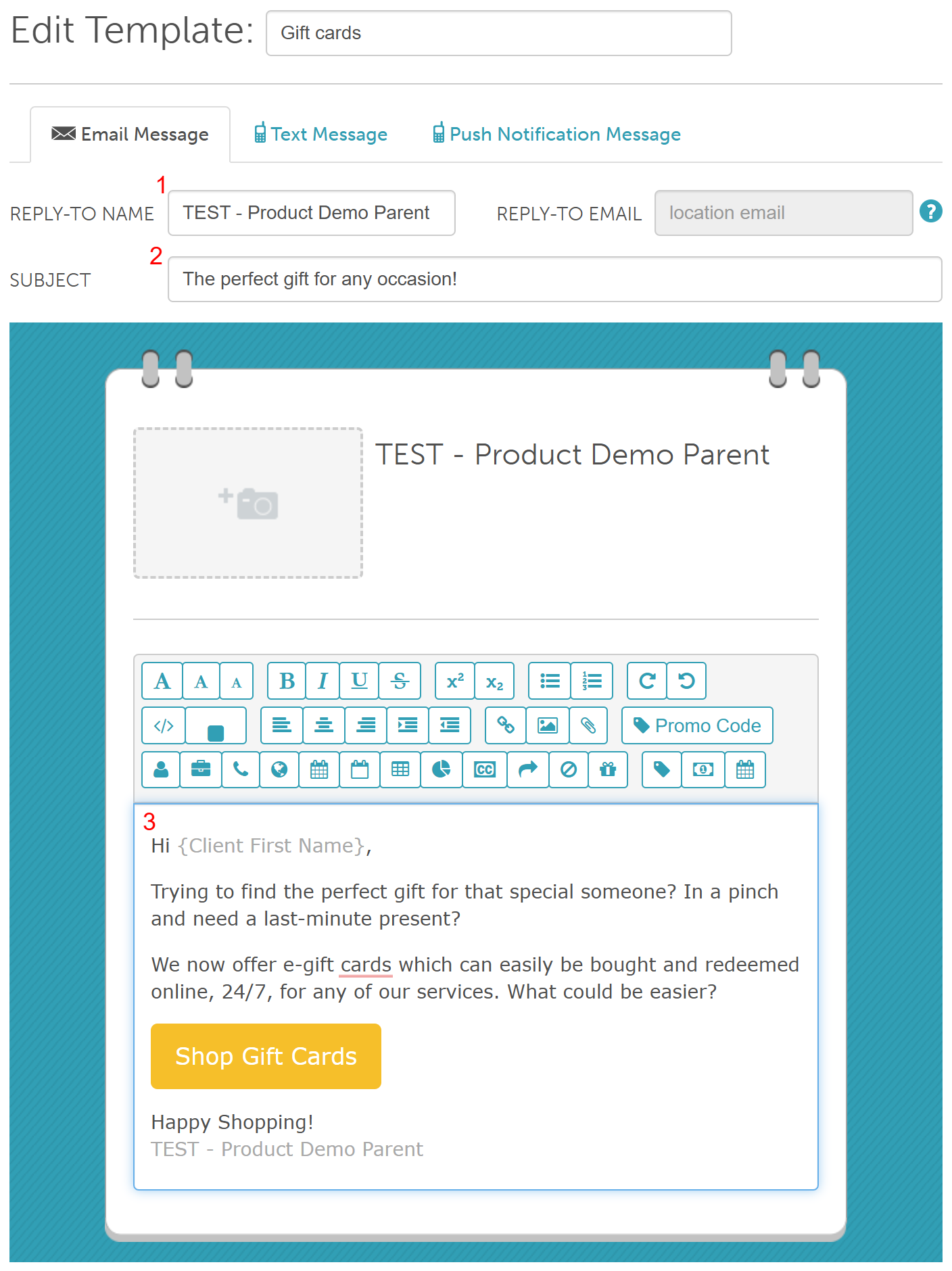
- When you are finished editing the template, select "Save" at the bottom


Generating Global Campaigns at the Parent Level
- Navigate to Marketing > Campaigns
- To access pre-saved campaigns, click the Templates tab or remain on the 'New Campaign' tab to create your own customized campaign
- From the 'Templates' tab, select your desired template to send. Hover over the template to see the 'View/Send' option; click 'Send'
- The template will be displayed for review and allow you to make any final changes, including changing the repy-to-email email address to the preferred child account
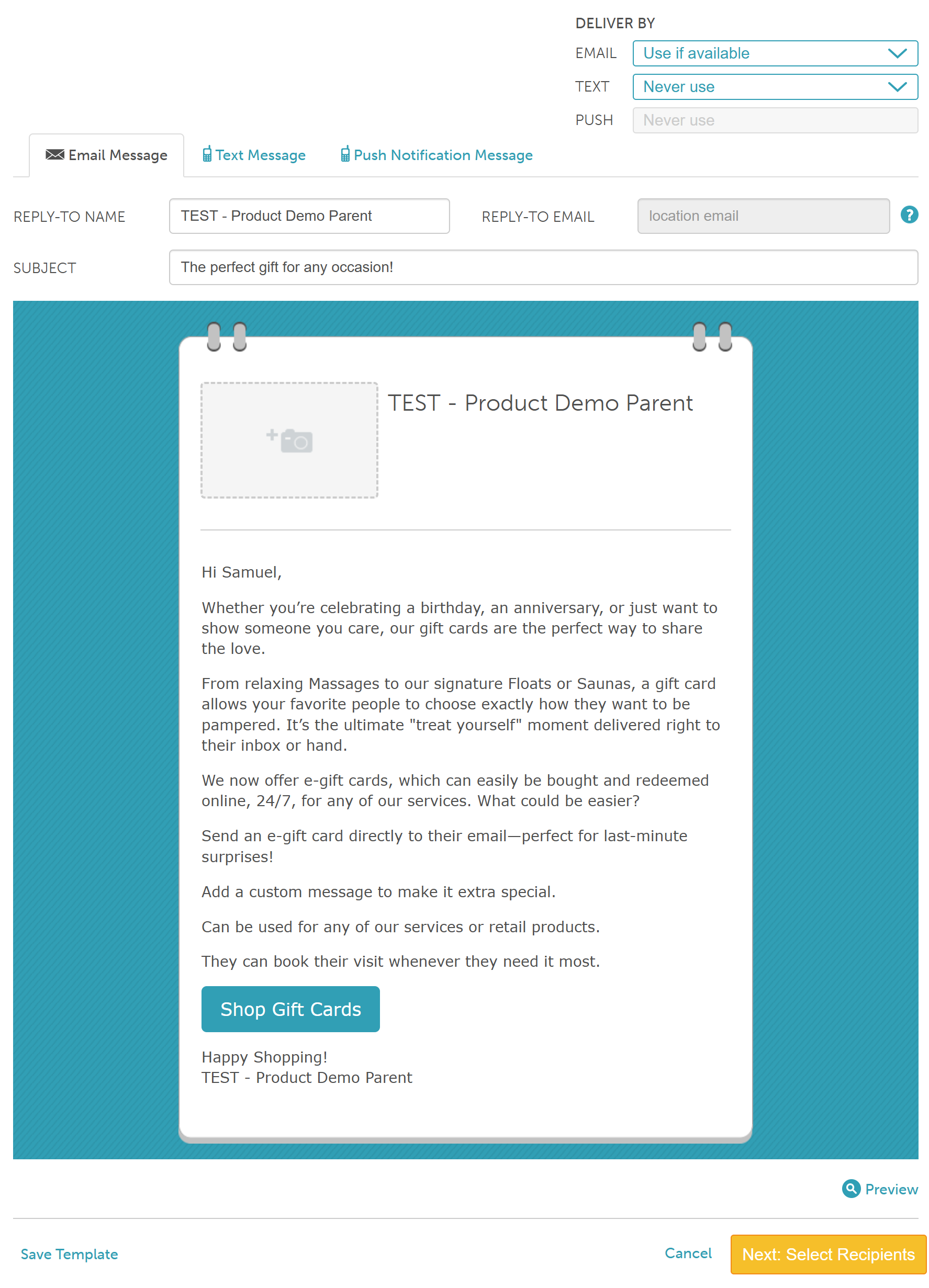
- Once changes are completed, select Next: Select Recipients to be directed to the filter page
- Select your desired filters; you can learn about each filter here
- You can also search for clients by name, phone number, and email address using the search box
- To view and edit the clients selected to receive the campaign before sending, select 'View' next to the client count
- Once satisfied with your recipient list, you can choose to send the campaign now or later. If you choose later, you can select a date and time for the campaign to be sent.
- Click on the Send button to send the campaign now
- On the Campaigns Sent tab, you will be able to view all campaigns that were sent.


Generating Global Campaigns at the Child Level
- From the child account, navigate to Marketing > Campaigns
- To access local campaigns, click the Templates tab. Alternatively, you can stay on the 'New Campaign' tab and click the drop-down arrow next to 'Write Your Own' to access global campaigns
- In the dropdown, parent-level campaigns can be identified by the globe icon
- Select any template. The selected template will be displayed
- Here you can:
- Choose the delivery method for the campaign
- By default, email is selected, but you can also choose and customize templates for SMS and push notifications (if your business uses the guest app)
- Make further edits to the template, including changing the reply-to-email
- Save Template: Save the changes to the child level
- Preview: View the template before sending
- Cancel: Remove the displayed template from the screen
- Once changes are completed, select Next: Select Recipients to be directed to the filter page
- Select your desired filters; you can learn about each filter here
- You can also search for clients by name, phone number, and email address using the search box
- To view and edit the clients selected to receive the campaign before sending, select View next to the client count
- Once satisfied with your recipient list, you can choose to send the campaign now or later. If you choose later, you can select a date and time for the campaign to be sent.
- Click on the Send button to send the campaign now
- On the Campaigns Sent tab, you will be able to view all campaigns that were sent.


For more information, contact us at support@mytime.com or (385) 233-6964.
Related Articles:
Direct / Indirect Bookings & Revenue Generated by Marketing Campaigns
Was this article helpful?
That’s Great!
Thank you for your feedback
Sorry! We couldn't be helpful
Thank you for your feedback
Feedback sent
We appreciate your effort and will try to fix the article